
Large-Scale Structural Challenges: Engineering Lessons from Arecibo

Updated: Mar 12
The Arecibo Observatory in Puerto Rico was more than just an astronomical landmark; it was one of the 20th century’s greatest displays of engineering audacity.
Featuring a 305-meter (1,000-foot) diameter reflecting dish, it held the title of the world’s largest single-aperture radio telescope for decades.

1. Innovative Structure and Design
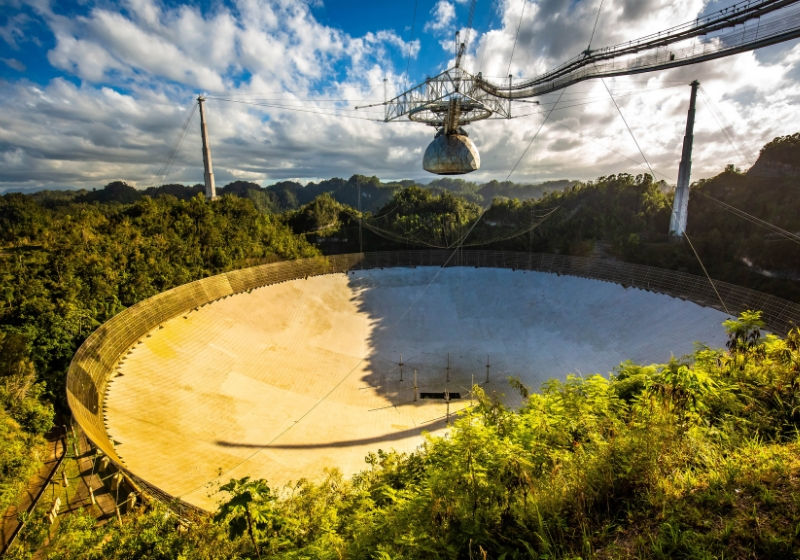
Unlike steerable telescopes, Arecibo was built by utilizing a natural limestone sinkhole.
The Spherical Reflector: Comprised of 38,778 perforated aluminum panels suspended over a network of steel cables. Its spherical geometry (rather than parabolic) allowed the telescope to "scan" different parts of the sky by moving the upper receiver platform.
The Suspended Platform: A massive 900-ton structure suspended 150 meters (492 feet) above the dish by 18 main cables connected to three reinforced concrete towers.
The Gregorian Dome: Added in the 1990s, this complex sub-reflector system corrected spherical aberration and enabled unprecedented precision.

2. Purpose and Embedded Systems
Arecibo operated across three primary fronts: radio astronomy, aeronomy (atmospheric studies), and planetary radar.
High-Power Transmitters: Capable of beaming radio waves to planets and asteroids. The signal return time allowed for the calculation of distances and shapes with metric precision.
Cryogenic Cooling Systems: Receivers had to be cooled to temperatures near absolute zero (15K) to reduce thermal noise and capture extremely faint signals from deep space.

3. Technical Operation
The fundamental principle was the focusing of electromagnetic waves. Waves would strike the fixed reflector and be directed toward the receivers on the mobile platform. By moving the platform along a circular track and an azimuthal arm, the telescope could track celestial objects as the Earth rotated.
4. Anatomy of the Collapse (December 2020)
The collapse was not an isolated event, but a cascading failure resulting from material fatigue and environmental factors:
Cable Fatigue: In August 2020, an auxiliary cable slipped out of its socket. In November, a main cable unexpectedly snapped.
Socket "Pull-out": Investigations revealed that the steel cables were gradually sliding out of the zinc-poured sockets (a phenomenon known as creep).
External Factors: Decades of exposure to tropical humidity, hurricanes (such as Hurricane Maria in 2017), and earthquakes accelerated the structural degradation.

5. Lessons Learned for Modern Engineering
The end of Arecibo provided invaluable data for the maintenance of large-scale infrastructure:
Redundancy is Not Eternal: The structural redundancy calculated in the 1960s did not account for the extreme load redistribution following the initial cable failure.
Real-Time Structural Health Monitoring (SHM): Today, fiber optic sensors and AI would be critical in detecting micro-movements in cables before a catastrophic failure.
Aging of Composite Materials: The behavior of zinc in sockets under constant tension for 50 years showed that design life cycles require constant empirical review.

Technical Trivia
The Arecibo Message: In 1974, the telescope beamed a binary message toward the M13 star cluster, containing data about human DNA and our position in the solar system.
Cinema: The site was the setting for the climax of the film 007: GoldenEye and the movie Contact.
Precision: Despite its size, the dish surface had an error tolerance of only a few millimeters to maintain radio wave fidelity.
Want to see more content like this? Visit our Blog's main page!
#AreciboObservatory #StructuralEngineering #CivilEngineering #FailureAnalysis #MaterialFatigue #StructuralHealthMonitoring #LargeScaleEngineering #PredictiveMaintenance #CableInspection #SteelCableFatigue #ForensicEngineering #RadioAstronomy #RadioTelescope #Telecommunications #RFEngineering #DeepSpaceCommunication #PlanetaryRadar #MicrowaveSystems #GregorianDome #SpaceSignals #SignalProcessing #TechnicalAstronomy #AreciboPuertoRico #NationalScienceFoundation #SETI #SpaceExploration #HistoryOfEngineering #SpaceScience #AstronomyHistory #USEngineering #AreciboCollapse #LessonsLearned #RiskEngineering #StructuralResilience #CriticalInfrastructure #AgingInfrastructure #CaseStudy #EngineeringCaseStudy #AreciboMessage #SearchForExtraterrestrialIntelligence #GoldenEyeLocation #ContactMovie #NikolaTeslaLegacy #EngineeringIcons #EngineeringMysteries #Sustainable_Automated_Engineering #SAE #EngineeringRetrospective2025 #TechInnovation #TechnicalLiterature #EngineeringBlog #TechnicalWriting #USA_Brazil_Engineering


Comments