
From Microgeneration to Industry 4.0: The Definitive Guide to Energy Transition in Electrical Engineering

A Special Dedication: The Voice of Our Community
The article you are reading right now was born directly from interactions with our technical community.
At E.S.A., we believe that scientific knowledge-sharing should reflect the real-world questions and challenges faced by those who experience the electrical sector daily.
Therefore, this post is entirely dedicated to our reader and enthusiast Winicius Nogueira Azevedo.
Through our suggestion box, Winicius requested a deep and comprehensive overview of one of today's most vital topics: Issues related to energy, electrical engineering, energy transition, and the power industry as a whole.
Winicius, grab your coffee. Let's move past the surface of commercial debates and dive deep into the mathematics, standards, and technological vectors driving the global industry's greatest paradigm shift.
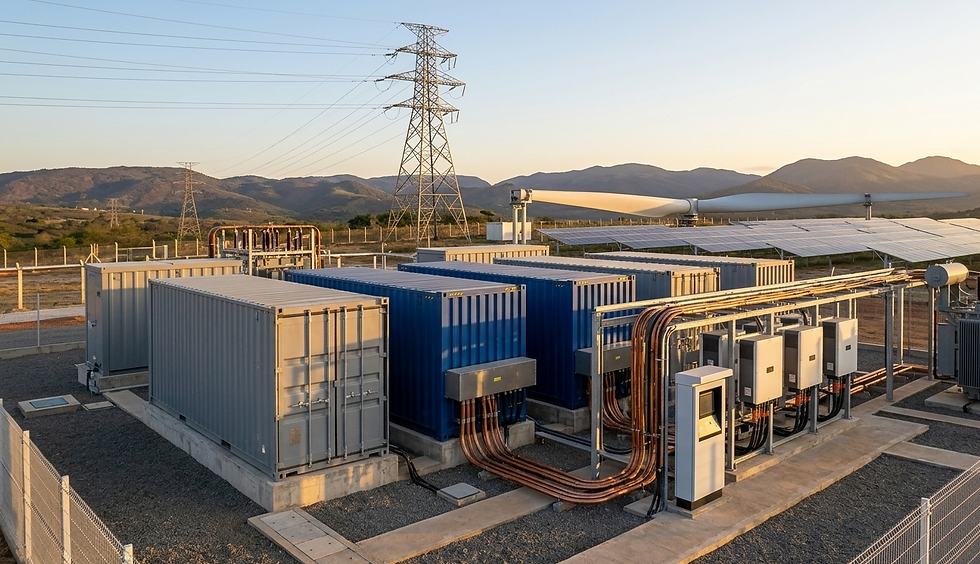
The Global Scenario: What Exactly Is the Energy Transition?
In mainstream media, the energy transition is frequently oversimplified as merely replacing fossil fuels with residential solar panels.
In electrical power engineering, however, the phenomenon is defined by a structural and stochastic change in the load flow matrix.
We are migrating from a classic, unidirectional Centralized Generation model to highly decentralized grids, where the industrial consumer takes on the role of a Prosumer (simultaneous producer and consumer).
The Brazilian Grid Paradox
While the world races against time to decarbonize thermoelectric power grids, Brazil operates at the vanguard: between 80% and 85% of our electricity matrix is already renewable, sustained by hydropower and the massive expansion of wind and solar photovoltaic sources.
Consequently, the challenge for a domestic engineer is not to clean up generation at the transmission level, but rather to mitigate the impacts of source intermittency and design the overhaul of industrial facility infrastructures to withstand this new load dynamic.

Technological Vectors: Engineering at the Frontline
To enable the energy transition without compromising operational continuity or violating selectivity and protection boundaries coordinated by standards such as NBR 5410 (low voltage) and NBR 14039 (medium voltage), we rely on three technological pillars:
1. BESS (Battery Energy Storage Systems)
The fundamental equation of the electrical power sector has always been the instantaneous equilibrium between generation and load. With intermittent sources, large-scale storage via BESS becomes mandatory.
Peak Shaving: Managing the load curve to reduce consumption during peak hours (time-of-use pricing) by discharging lithium or flow battery banks when the contracted demand approaches its threshold.
Power Quality: Millisecond-range response times to damp electromechanical transients, voltage sags, and momentary interruptions that could otherwise paralyze entire production lines.
2. Digital Substations and the IEC 61850 Standard
The traditional industrial substation, controlled by miles of copper wiring and isolated relays, is being replaced by the digital standard of the IEC 61850 norm.
Here, protection and control data traffic occurs over a fiber-optic bus using ultra-high-priority digital messaging (GOOSE and Sampled Values).
This not only drastically eliminates physical points of failure but also opens the door for analytical predictive maintenance of medium- and high-voltage transformers and circuit breakers.
3. Process Thermal Electrification
Severe decarbonization requires replacing combustion boilers and furnaces (powered by natural gas, fuel oil, or coal) with purely electrical systems.
Key highlights include electromagnetic induction heating (where eddy currents or Foucault currents perform thermal work directly within the material's core) and high-efficiency industrial heat pumps.
Historical Trivia: The Return of Direct Current (DC)
In the late 19th century, Nikola Tesla won the "War of the Currents" against Thomas Edison, proving that Alternating Current (AC) was superior for long-distance power transmission due to how easily transformers could step up voltage.
However, the 21st century brought a plot twist: photovoltaic panels generate in DC; BESS batteries store in DC; and industrial electric vehicle fleets demand DC fast charging. Modern engineering is now forced to design highly complex hybrid (AC/DC) industrial microgrids to prevent successive losses across rectification and inversion stages.

Automation and Sustainability: Mastering Industry 4.0
The energy transition is inefficient if it is not automated.
As the classic control engineering adage goes: what gets measured gets optimized.
Active Energy Efficiency in Motors
Electric motors account for more than 60% of the dynamic consumption in an industrial plant. Engineering plays a critical role here by replacing legacy assets with motors rated at IE4 or IE5 (Super/Ultra Premium) efficiency classes.
To extract maximum efficiency, these motors are driven by Variable Frequency Drives (VFDs) equipped with vector control and embedded intelligence, communicating via industrial protocols (Modbus TCP, Profinet, or EtherNet/IP) with supervisory systems (SCADA). The system dynamically adjusts motor speed and torque to match real-time process demand, eliminating no-load waste.
Artificial Intelligence and the Free Energy Market (ACL)
With the progressive opening of the Free Energy Market (ACL), electricity has become a strategic commodity. Machine Learning algorithms collect historical factory floor consumption data, cross-reference it with production scheduling, and monitor the behavior of the Difference Settlement Price (PLD), determining the exact moment to buy contracts, dispatch self-generation, or deploy the battery bank.
Essential Academic Literature and References
For engineers seeking to specialize in modeling these new power and energy systems, the theoretical foundation requires looking beyond commercial manuals. We recommend the following mandatory references:
Power Systems: Elements of Power System Analysis by William D. Stevenson Jr. remains the mathematical foundation for load flow and fault analysis.
Power Quality: Electrical Power Systems Quality by Roger C. Dugan is essential to understanding harmonic distortions introduced by transition-era power electronics.
Industrial Automation: Industrial Network Security by Eric D. Knapp provides the necessary insight into the secure convergence of Operational Technology (OT) and IT networks within modern substations.

Technical Curiosity: Power Factor and the "Beer Mug Analogy"
One of the largest energy bottlenecks in industry is the flow of Reactive Power (Q), generated by the magnetic fields of motors and transformers. To understand Power Factor, imagine a mug of beer: the liquid represents Active Power (P), which performs the useful work (turning the motor shaft). The foam represents Reactive Power (Q), which is necessary to sustain the magnetic field but performs no actual work. The total volume of the mug is Apparent Power (S).
If your mug has too much foam, you overload the delivery infrastructure (conductors and transformers) and pay heavy penalties to the utility company. The precise sizing of automatic power factor correction banks (capacitor banks) and active harmonic filters is what ensures your industry consumes the "liquid" and minimizes the "foam."
Comparative Summary: The Infrastructure of the Transition
Technological Vector | Operational Base | Engineering Impact | Reference Standard |
BESS (Batteries) | Electrochemistry / DC | Demand control and transient mitigation | NBR 5410 / IEC 62933 |
Digital Substations | Fiber Optics / Networking | Predictive maintenance and millisecond protection | IEC 61850 |
Thermal Electrification | Induction / Thermodynamics | Elimination of fossil fuels in industrial processes | NBR 5410 / NBR 14039 |
IE4/IE5 Automation | Power Electronics | Dynamic torque and speed optimization | IEC 60034-30-1 |
Engineering with Purpose
The energy transition is not a bureaucratic milestone meant for the coming decades; it is being drafted right now, bit by bit, wire by wire, on the factory floor.
At E.S.A., we translate complex mathematical models and stringent regulatory requirements into high-performance applied engineering.
Our role is to ensure your transition to Industry 4.0 occurs with maximum legal, technical, and operational security.
Once again, our thanks to our reader Winicius Nogueira Azevedo for the excellent technical prompt that sparked this guide.
And what about you? What is the next engineering, automation, or energy challenge you want to see demystified here?
Access our suggestion form. The next comprehensive article could be engineered specifically for your project.


Comments