
El Niño 2026 and Engineering: How to Protect Your Infrastructure from Severe Storms and Heatwaves
- Elétrica Sustentável Automatizada

- 1 day ago
- 6 min read
If you work in engineering, facility management, or industrial infrastructure today, ensuring operational continuity, electrical equipment integrity, and lightning protection are likely daily priorities. Whether managing a large-scale industrial facility, a corporate complex, or a residential development, grid stability and building resilience are directly tied to financial health and site safety.
However, with the consolidation of El Niño in 2026, operational environments in Brazil and across the globe are facing one of the most severe stress tests in recent years. Extreme weather events are no longer sporadic or isolated anomalies; they have become critical variables in executive engineering design, preventative maintenance, and asset management. The combination of prolonged heatwaves, severe storms, and high lightning strike density demands an approach that goes far beyond reactive repairs.
In this article, we explore the complete trajectory of El Niño, diving into its oceanic and atmospheric origins, the historical context of major past events, the physics behind thermal spikes and severe storms, and above all, how modern electrical and civil engineering can safeguard installations against blackouts, sensitive equipment burnout, and structural failures.
The Historical Context: The Science Behind ENSO and Lessons from the Past
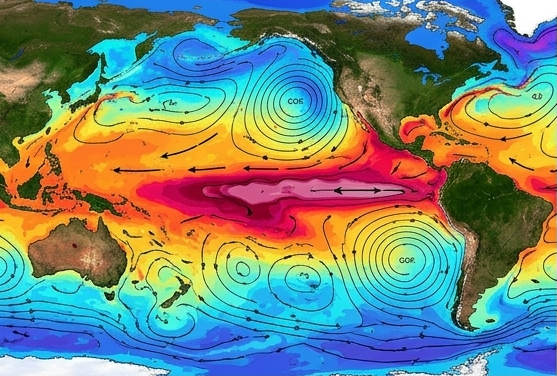
To understand the magnitude of El Niño 2026's impacts on urban and industrial infrastructure, we must step back in time and analyse the physics of the phenomenon. What is popularly known as El Niño is part of a global oceanic-atmospheric dynamic termed ENSO (El Niño–Southern Oscillation).
Under neutral conditions, trade winds blow from east to west across the Equatorial Pacific Ocean, "pushing" sun-warmed surface waters towards Asia and Oceania. This movement drives the upwelling of cold, deep waters along the coast of South America. During an El Niño event, these trade winds weaken (and occasionally reverse). Without the force of the trade winds, a massive pool of warm water accumulates in the central and eastern equatorial Pacific, drastically altering global air circulation, moisture transport, and temperature patterns.
Although the phenomenon was named centuries ago by South American fishermen — who noticed unusual seawater warming and reduced fish stocks near Christmas time — it was only in the second half of the 20th century that the scientific and engineering communities began measuring and documenting its devastating impacts on infrastructure.

The Chronology of Major Events and Engineering Insights
Modern history is marked by major El Niño events that served as turning points for engineering standards and energy contingency planning:
1982–1983 (The Dawn of Global Monitoring): One of the first events monitored in real-time by satellites and ocean buoys. It caused record-breaking rainfall in southern regions, leading to floods that compromised bridges, highways, and step-down electrical substations, highlighting the need to re-evaluate flood levels for civil and electrical projects.
1997–1998 (The "Super El Niño"): Widely considered one of the most intense events of the 20th century. The impacts were severe: extreme droughts in northern tropical regions contrasted with torrential rains in the south and southeast. Power distribution networks collapsed under severe storm forces, and massive transformer burnouts from lightning strikes prompted comprehensive overhauls of surge protection guidelines over the following decades.
2015–2016 (The Era of Heat Records): Marked by unprecedented global temperatures. Successive heatwaves led to historic surges in electrical demand for air conditioning and industrial cooling systems. Urban distribution grids, operating at peak current-carrying capacity, suffered cascade trips due to cable and substation overheating.
2023–2024 (Increased Frequency): This cycle reinforced scientific consensus that ENSO events are becoming more frequent and pronounced. It underscored the critical need to coordinate Lightning Protection Systems (LPS / SPDA) with internal surge protection devices (SPDs).
The key lesson from history for 2026 is clear: facilities and industrial plants designed or maintained using conservative historical averages remain vulnerable. Engineering practice must build climate stress margins into the core of its technical specifications.

Infrastructure's Two Greatest Threats in 2026: Extreme Heat and Severe Storms
The impacts of El Niño 2026 manifest across buildings and electrical systems through two opposing yet equally destructive forces: prolonged thermal stress and high-intensity atmospheric discharges.
1. Thermal Stress on Power Grids and Electrical Equipment
During El Niño-driven heatwaves, cooling and HVAC demand reaches continuous peak consumption for hours or days at a time. This operational profile triggers a domino effect across electrical infrastructure:
Joule Heating and Loss of Ampacity: A conductor's current-carrying capacity (ampacity) depends directly on ambient temperature. As ambient temperatures rise, a conductor's ability to dissipate heat decreases. If power consumption simultaneously spikes, heat generated by Joule Heating (I²R) drives conductor temperatures above the safe operational limits of insulation materials (such as PVC, XLPE, or EPR).
Premature Insulation and Dielectric Degradation: Excessive heat accelerates the thermal ageing of synthetic insulation on cables and busbars. In oil-immersed transformers, elevated operating temperatures accelerate oil oxidation and cellulose paper insulation breakdown, potentially leading to severe internal short circuits.
Nuisance Tripping of Thermal-Magnetic Circuit Breakers: Thermal trip mechanisms rely on calibrated bimetallic strips sensitive to heat. In poorly ventilated switchboards operating under high ambient temperatures, breakers can suffer "false positive" trips or operate below design current, shutting down production lines or critical systems without an actual electrical fault.
2. Severe Storms and Lightning Discharges (LPS / SPDA)
The accumulation of warm, humid air masses in the atmosphere fosters deep convection and the formation of massive Cumulonimbus clouds. These atmospheric formations act as static electricity generators, producing storms with extremely high lightning strike densities (strikes/km²/year).
Direct and indirect risks to assets include:
Direct Structural and Thermal Damage: A direct strike to a facility lacking an adequately rated Lightning Protection System can cause concrete spalling, masonry shattering, and immediate fire hazards due to localized extreme heating at the point of strike.
Induced Voltage Surges and Transients: A strike does not need to hit the building directly to cause catastrophic damage. A strike hundreds of metres away generates intense electromagnetic fields that induce high voltage surges on incoming power and data lines. Without coordinated protection, these transients destroy variable frequency drives (VFDs), elevator control boards, Fire Indicator Panels (FIPs), and IT server racks.

Practical Engineering Guide: Safeguarding Your Infrastructure in 2026
To mitigate these risks, the engineering team at E.S.A. (Elétrica Sustentável Automatizada) has structured a standardized action plan focused on prevention, system resilience, and technical compliance.
1. Lightning Protection System (LPS) Audit & Compliance (ABNT NBR 5419 / AS/NZS 1768)
Proper lightning protection requires a thorough diagnostic review across key system components:
Risk Management: Recalculate required protection levels (Levels I through IV) accounting for elevated regional lightning flash densities and increased precipitation rates.
Air-Termination & Down-Conductor Inspection: Ensure air terminals (Franklin rods or Faraday cage meshes) and down-conductors are intact, free from corrosion or loose mechanical connections, and spaced correctly to eliminate dangerous side-flashing.
Earthing Subsystem Measurement: Test electrical continuity across the earthing grid and verify equipotential bonding between all structural metallic masses and the electrical earth earth-bar.
2. Coordinated Internal Surge Protection (SPD Integration)
Roof-mounted lightning protection defends the physical structure, but Surge Protection Devices (SPDs) protect sensitive electronic assets inside. Implementation must be organized into lightning protection zones (LPZ):
Class I / Type 1 SPDs: Installed at the main switchboard (MSB / QGBT) to divert partial direct lightning currents to earth.
Class II / Type 2 SPDs: Installed at sub-boards and distribution boards to clamp residual overvoltages and switching surges.
Class III / Type 3 SPDs: Installed adjacent to sensitive terminal loads (such as PLCs, UPS systems, and IT equipment) for fine-level protection.
3. Thermographic Scanning and Preventative Switchboard Maintenance
Infrared thermography is the most effective non-destructive testing (NDT) method for diagnosing electrical faults before catastrophic failure occurs. Using calibrated thermal imaging equipment, engineers identify:
Hotspots caused by loose terminations, bolts, or lug connections.
Phase load imbalances across switchboard busbars.
Overloaded copper busbars and feeder cables.
Internal contact degradation in contactors and circuit breakers under heavy thermal loads.
4. Power Quality Analysis and Power Factor Correction
With increased non-linear loads (such as VFDs driving HVAC compressors), facilities face elevated total harmonic distortion (THD) and poor power factor. Deploying power quality analyzers allows engineers to correctly size harmonic filters and power factor correction (PFC) capacitor banks, preventing utility penalties and eliminating unnecessary thermal stress on distribution conductors.

Conclusion & Next Steps for Your Facility
History and science demonstrate that El Niño 2026 should not be viewed as an inevitable fatality, but rather as a key decision driver to strengthen building and industrial engineering. Investing in standardized preventative maintenance, LPS (SPDA) audits, SPD coordination, and thermographic diagnostics shifts from being a mere operational expense to consolidating as a strategic pillar for risk management and business continuity.
E.S.A. (Elétrica Sustentável Automatizada) brings together deep technical expertise in engineering design, official LPS compliance reports, power quality analysis, and comprehensive climate risk mitigation plans tailored to your infrastructure.
Is your facility or industrial plant properly prepared to face the extreme climate conditions of 2026?
Do you have a project in mind or underway? Contact E.S.A. today for a consultation and proposal with our industry specialists!
Did you enjoy this content on the impacts of climate on engineering?
Follow the E.S.A. blog for more articles on infrastructure, electrical engineering, atmospheric discharge safety, and sustainable energy management.
#ElNino2026 #ElectricalEngineering #LPS #LightningProtection #ASNZS1768 #SPD #SurgeProtection #Heatwaves #SevereStorms #ElectricalInfrastructure #PowerQuality #ElectricalThermography #ClimateResilience #PreventativeMaintenance #EnergyManagement #JouleHeating #Switchboards #MSB #ElectricalSafety #ESA #ESAEngineering #EletricaSustentavelAutomatizada


Comments