
Structural Down Conductors for LPS: Demystifying EVERYTHING (Standards, Continuity, and Myths)

If you work in property management, serve on residential or commercial condominium boards, or manage building infrastructure, the down-conductor subsystem of a Lightning Protection System (LPS) often raises critical questions.
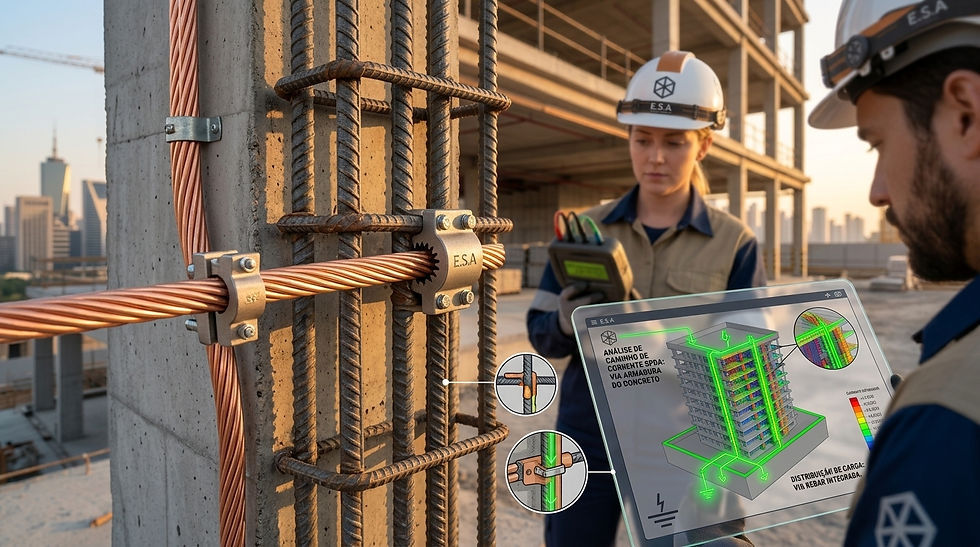
Using the reinforced concrete steel rebar as down-conductors — known as a Structural LPS — is an established practice strongly encouraged by standard ABNT NBR 5419:2015, however, it remains surrounded by myths regarding structural damage, corrosion, and inspection procedures.
In this article, we will completely demystify the use of structural down-conductors, covering normative criteria, electrical continuity testing, economic and aesthetic advantages, and the most common field errors.

The Technical Context: Why Use Concrete Rebar?
The fundamental principle of the down-conductor subsystem is to route the lightning surge current (which can exceed 100 kA) from the top of the building to the grounding system via the lowest impedance path possible.
Unlike traditional external conductors (such as copper or aluminum tapes fixed to the facade), the interconnected steel rebar mesh inside reinforced concrete offers significant advantages:
Parallel Path Multiplication: Hundreds of electrically interconnected vertical and horizontal steel bars divide the total surge current. The current passing through each individual conductor becomes a tiny fraction of the total.
Drastic Reduction of Impedance and Inductance: Dispersing the current through a three-dimensional grid significantly reduces the electromagnetic field inside the building, protecting sensitive electronic equipment (SPM — Surge Protection Measures concept).
Proteção Natural contra Intempéries e Furtos: Natural Protection Against Weathering and Theft: Concrete acts as a mechanical and environmental protective enclosure for the steel bars, eliminating exposure to vandalism and cable theft.
The drastic temperature rise due to Joule heating applied to energy dissipation is given by:
P = R x I²
Because current (I) is divided across dozens of parallel-connected steel bars, equivalent resistance (R) plummets, making thermal heating within the rebar virtually non-existent during a lightning strike.

Chronology of Normative Evolution for Structural LPS in Brazil
+---------------------------------------------------------------+
|  1977-1993: EXCLUSIVE EXTERNAL CONDUCTOR PHASE                |
|  * Predominance of exposed copper cables on facades.          |
|  * High material costs and vulnerability to theft/corrosion.  |
|  * Few down-conductors and high concentrated impedance.       |
+---------------------------------------------------------------+
                               |
                               v
+---------------------------------------------------------------+
|  1993-2015: CONSOLIDATION OF STRUCTURAL LPS (NBR 5419)        |
|  * Express permission to use reinforced concrete rebar.  |
|  * Requirement for welded connections or proper wire ties.    |
+---------------------------------------------------------------+
                               |
                               v
+---------------------------------------------------------------+
|  2015-PRESENT: ERA OF NBR 5419:2015 (PARTS 1 TO 4)            |
|  * Strict electrical continuity verification(R <= 0,2 Ω).     |
|  * Requirement of Rebar Clips / interconnection connectors.   |
|  * Focus on equipotential bonding and surge mitigation (SPM). |
+---------------------------------------------------------------+
The conclusion of this normative evolution is clear: using structural rebar as down-conductors is not an improvisation, but rather the preferred and safest solution recommended by Brazilian standard ABNT NBR 5419.
The Three Regulatory Pillars for Structural LPS Down-Conductors
Implementing and validating a structural LPS requires adherence to a strict regulatory framework:
Assured Electrical Continuity (ABNT NBR 5419-3)
Vertical reinforced concrete bars must maintain guaranteed electrical continuity from the roof to the foundation. Interconnections between steel bars can be made using electrical welding, specialized mechanical connectors (Rebar Clips), or twisted wire ties with adequate overlap.
Micro-ohm Meter Testing (R ≤ 0,2 Ω)
Measuring electrical continuity is the decisive test. Using a micro-ohm meter with the 4-wire method (Kelvin method) and a minimum test current of 10A, the electrical resistance between the highest point of the air-termination system and the base of the building must not exceed 0,2 Ω.
Fire Department Requirements (AVCB/CLCB) and Insurers
Buildings utilizing a structural LPS must prove system efficiency through a Technical Compliance Report with an ART registered with CREA. Lacking an updated report can invalidate property insurance policies in the event of lightning-related losses.
Architectures and Execution Protocol of E.S.A
To enable or regularize structural LPS in new or existing buildings, E.S.A. follows a four-phase engineering workflow:
[BUILDING LPS DIAGNOSIS AND AUDIT]
|
v
+------------------------------------+
| BUILDING IN DESIGN / CONSTRUCTION  |
| * Detailing of Rebar Clips in      |
|   perimeter columns.               |
| * Provision of junction boxes      |
|   (Rebar Boxes) in concrete.       |
+------------------------------------+
|
+------------------------------------+
| EXISTING BUILDING (RETROFIT)       |
| * Rebar mapping using a pacometer  |
|   / structural scanner.            |
| * Selective openings for           |
|   continuity testing (R ≤ 0.2 Ω    |
+------------------------------------+
|
v
[MICRO-OHM METER MEASUREMENT - KELVIN METHOD (10A)]
|
v
[COMMISSIONING, TECHNICAL REPORT, AND ART ISSUANCE]
Phase 1: Electrical Audit and Column Mapping: Visual inspection and review of structural and formwork drawings, selecting perimeter columns according to the protection level (I, II, III, or IV).
Phase 2: Electrical Continuity Testing: Application of direct test current (10 A) to measure the equivalent ohmic resistance of the rebar grid.
Phase 3: Interconnection Box Installation (Rebar Boxes): Opening access points fitted with bimetallic brass/bronze connectors to attach air terminations and equipotential bonding to the MEB (Main Earthing Busbar).
Phase 4: Commissioning, Technical Report, and ART: Issuance of the LPS Inspection Report signed by an Electrical Engineer, accompanied by a Technical Responsibility Note (ART) filed with CREA-SP.

Comparison Table: Structural LPS vs. Conventional LPS
Evaluation Parameter | Structural LPS (Concrete Rebar) | Conventional LPS (External Conductors) |
Facade Aesthetics | 100% invisible (no exposed conduits or tapes). | Visible (cables, tapes, and clamps on the facade). |
Vulnerability to Theft | Zero (conductors embedded in concrete). | High (frequent copper cable theft). |
Implementation Cost | Up to 70% lower (leverages existing steel). | High (purchasing conductors and fasteners). |
Maintenance / Corrosion | Minimal (steel protected from weathering). | Constant (exposure to sea spray, rain, and sun). |
Impedance and Magnetic Field | Very low (hundreds of parallel paths). | High (few concentrated down-conductors). |
NBR 5419 Compliance | Preferred and recommended solution. | Alternative/secondary solution. |

Main Myths About Structural LPS
Myth 1: "A lightning strike will crack or damage the reinforced concrete."
False. The current surge of a lightning strike lasts milliseconds (10 µs to 350 µs). Because current is divided across hundreds of parallel rebars, thermal energy dissipated per meter of steel bar is negligible—insufficient to generate thermal expansion that could crack the concrete.
Myth 2: "It is impossible to perform maintenance measurements on an embedded LPS."
False. NBR 5419 mandates inspection/junction boxes (Rebar Boxes) at strategic locations (top and base). Micro-ohm meter testing (10 A) validates continuity in seconds without breaking down walls or exposing rebar.
Myth 3: "Lightning current causes accelerated corrosion of the steel rebar."
False. Steel corrosion in concrete is an electrochemical process linked to moisture, oxygen, and carbonation/chlorides. A short-duration impulsive lightning discharge does not alter the electrochemical state of the steel or accelerate corrosion.
How E.S.A. Can Help?
Structural LPS is the most technically efficient, aesthetically clean, and cost-effective solution for lightning protection in modern and existing buildings.
Ensuring your building or facility complies with ABNT NBR 5419:2015 protects structural integrity, prevents accidents, and avoids legal sanctions or delays when renewing AVCB / CLCB fire safety certificates.
E.S.A has a specialized team equipped to perform continuity testing with calibrated micro-ohm meters, technical audits, retrofit projects, and technical report issuance with ART registered at CREA-SP.
#Structural_Down_Conductors_LPS #Structural_LPS #ABNT_NBR_5419 #LPS_Technical_Report #Electrical_Continuity_Test #LPS_Micro_Ohm_Meter #Lightning_Protection_System #E_S_A #Engineering #Use_of_Concrete_Rebar_as_LPS #Rebar_Clips_Connectors #Rebar_Box_Junction_Box #Continuity_Resistance_20_miliohms #Kelvin_Method_10A #LPS_Report_for_AVCB #ART_CREA_SP_LPS #Structural_Lightning_Rod_Condominium #Building_LPS_Retrofit #Structural_Lightning_Damage_Myth #LPS_Maintenance_Sao_Paulo


Comments